We exist to get people doing poetry.
Come and join us!
POETRY WHITCHURCH
2026 haiku competition
As part of the Caldecott festival of creativity, Poetry Whitchurch hosted our first poetry competition.
Judge Sian Hughes presided over 200+ entries and selected a winner and runner up in adult and under 18 categories. The theme that the Caldecott festival organisers chose was "countryside".
The winner of the over 18s prize was Phillip Williams and the runner up was Alison Patrick. The under 18 winner was Esme Blue and runner up was Duncan Cowan. The winners of each category won a £50 prize.


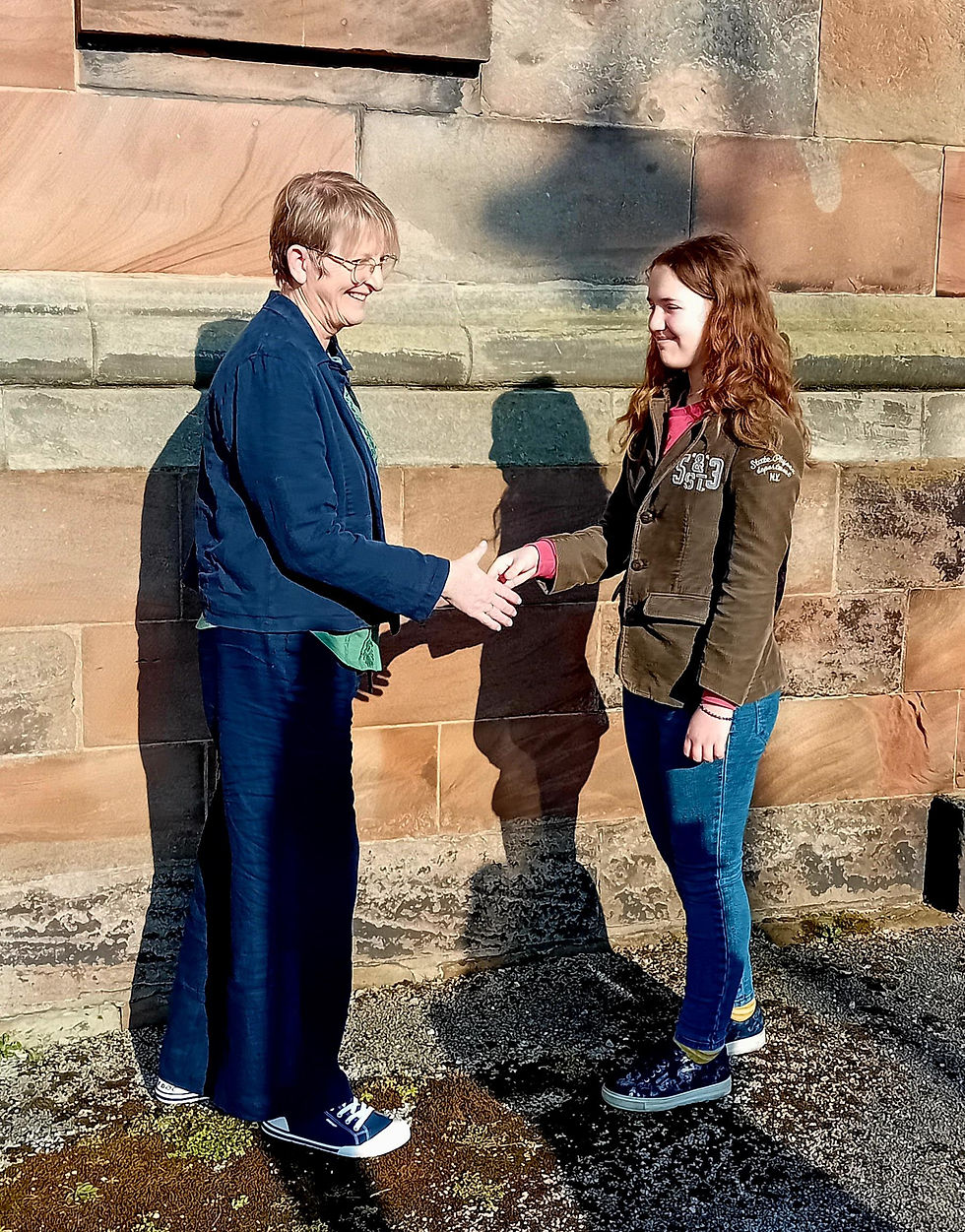
Judge Sian Hughes said:
My role as judge was a lot of fun. There was not a single entry that did not have something interesting, memorable, inventive or observant in it. For such small poems they really can pack a punch.
As I read and re-read them I began to look for poems where the short form did not seem to make the poet rush, or try to pack in too much. I admired those poems that seemed to take their time, and feel as if they spoke to me at a conversational pace, holding my attention closely to the subject matter but not trying to squeeze in enough for a whole page. I also grew to love those poems where there was not a single syllable wasted or used as padding. Some poets added a title - which I thought was a very clever way to give me more information and lead me gently into the poem without adding any official syllables.
A poem can choose which kind of camera lens it looks through. It can do a wide angle, then zoom in, it can sweep across the whole landscape from the point of view of a single person.
I loved On Mucklewick Hill - the use of the title gave us not only useful extra information, leaving the poet free to use all their syllables now we already know where we are, but it is such a great name for a hill, so rooted and earthy and full of the soil under your fingertips.
On Mucklewick Hill
Up here I can see
where I've been: path, rock, ridge, wood.
And where I'm going.
The description of the whole lanscape is four words, four simple syllables, and draws our eye across the whole map, with our feet firmly rooted where we stand. And the ending is so ethereal - it reminded me of an old song, and it stayed in my mind as clearly as anything you can sing. A single moment of vision, of clarity, of destiny and direction, and all with four syllables of landscape. Amazing. A wonderful second place poem - I wish I could have given two prizes so that one could win as well.
But in the end the final winner was a haiku that didn't even need to borrow a few syllables from a title to say everything. This one uses a zoom lens, and looks down at the ground where we are treading with our boots, and magnifies a moment, brings it into focus.
Even a boot-print
cups enough water to keep
each tadpole breathing.
There is so much subtle repetition of sound here, with the cups and keep framing the middle line, and the solid human boot-print that stamps down the ending to line one transforming into the soft ending of 'breathing' at the close, opening up the final moment of the poem in an unstressed syllable, a light, opening of air. It is a deeply positive poem, finding fragile life in a mundane moment, a place where human and animal life co-exist peacfully, and the poet is the watcher, the seer of unseen detail that opens our eyes to the world in a new way, finds wonder in a bootprint. I loved it. I knew when I read it, that I would never forget it, neither the words nor the visual image. So that is the winner.
In the under 18's category I was impressed by complex vocabulary, philosophy, challenging images and many memorable lines. As a category, these haiku were especially strong on details of the five senses, with the young poets doing a brilliant job of bringing in the sense of touch and smell to really ground the reader in the moment and make it come alive.
The runner-up had a totally memorable opening line, full of precise detail and great musical repetition of 'b' and 'd' sounds that make it read like an ancient story-telling poem. Listen to this:
upturned fodder beets
litter the poor sheep’s quarters
within farmers’ stew
Upturned fodder beets - isn't it wonderful? Like a drum? And so exact, and down to earth. The next line is just as good - litter the poor sheep's quarters - see how the sounds shift into a different gear, with plenty of repetition but sharper now, and still just as precise. The last line turns the haiku totally on its head, the quarters now relating to the sheep as meat. A horrific, visceral turn of events. It gets a highly commended runner-up.
The winner is this:
Drifts ( Great title! It could be a noun or a verb - and it opens the poem up to have at least two meanings, one for each. Brilliant!):
DRIFTS
Snow-feathered whiteness
fairy footprints lead us from
nowhere to nowhere.
Again the poem uses repetition and builds the sounds from the first 'feathered' through the soft 'f' sounds of the middle line, and leavs us with a totally memorable final line. How bold to repeat a whole word when you only have 17 syllables! And how totally effective, and evocative.
Thank you to every writer who sent us a poem. Thank you for all the hours of fun we had reading them and talking about them, and most of all for leaving me with so many wonderful little moments of revelation and eye-opening.